Conversion
How does Aurora compare to other ready-made OEM style radios on the market?
Is my radio suitable for conversion?
What do I need to send it in?
How long does the process take?
What if I have special or non factory installation considerations?
I have a 60s or early 70s Ford or Mercury radio (Mustang/Full Size/Trucks) and the tuning knob doesn’t move/ barely moves the dial or seems notchy.
I have a 20s/30s era firewall mount radio with remote tuning head on flexible shafts, such as Motorola or Philco Transitone. Can you work with these?
Installation
How do I wire my Aurora converted radio?
Do I need new speakers?
What type of speakers do I need?
My car has a speaker arrangement other than four. How does this work?
What if my car has a single front and rear speaker, or just a single dash speaker?
Does Sierra sell speakers?
My car uses oddly sized speakers or an unusual mounting arrangement. What do I do?
Using your Radio
How do I know what FM station I’m listening to on my converted factory AM only radio?
How do I switch over to AUX input?
How do I listen to a cassette or 8-track cartridge?
How do I adjust fader, balance, loudness, and other controls?
Other
Are there any other things to consider about the radio conversion process?
Conversion
How does Aurora compare to other ready-made OEM style radios on the market?
There are a handful of manufacturers making ready-made custom car stereo autosound units for many popular years and makes that are designed to bolt in and go.
These stereos are a great solution for budget-conscious owners who are looking for a more modern stereo in their classic without cutting the dash or installing some other hidden solution. Speaking for the quality of the electronics, most of these units tend to be on par with what can be expected from most economy and entry level stereos available through auto parts stores and third party car audio retailers, and are designed for mass production with a low price point in mind. Excellent for most driver quality installations.
Discerning clientele know the difference in fit, feel, and function, as well as the superior and pleasing audio quality of a well engineered amplifier.
Is my radio suitable for conversion?
Aurora products are designed to work with most 1920s-1980s car and truck factory AM, AM/FM, European Multiband and radios with 8 track or cassette players.
As a general rule of thumb, if your radio has a mechanical tuning dial, with or without memory preset buttons, with rotating control shafts or thumbwheels to control power, volume, tone, tuning etc, then it can be converted. Radios with any type of digital displays or clocks that began being introduced about the mid 1980s can not be converted with Aurora Design electronics.
What do I need to send it in?
Carefully package your radio and send it in with the order form. When it arrives it will undergo pre-inspection before we request any type of billing or initial payment. If arranged ahead of time, business checks or postal money orders may be enclosed.
It’s up to you to know what you want in advance. While we can offer radio configuration recommendations based on your vehicle or speaker configuration, we do not offer any type of professional or other advice. Your best bet is to consult with your local installer or restorer for advice on what you might need.
How long does the process take?
It varies, but ten to fourteen days is typical.
What if I have special or non factory custom installation considerations?
Contact us in advance. Any external jacks provided standard or installed by request are usually placed primarily where there is convenient space inside the radio case and secondarily where they’re conveniently accessible on the outside.
The most common special requests are in installations where clearance between one side of the radio might be an issue, such as tri-five chevies with a rain gear wiper conversion. Another are in Concours or other vehicles where the original harness and wiring is being retained. In these cases the radio’s original plugs or wiring will be reused if possible; otherwise a modern style molex plug and pigtail will be attached.
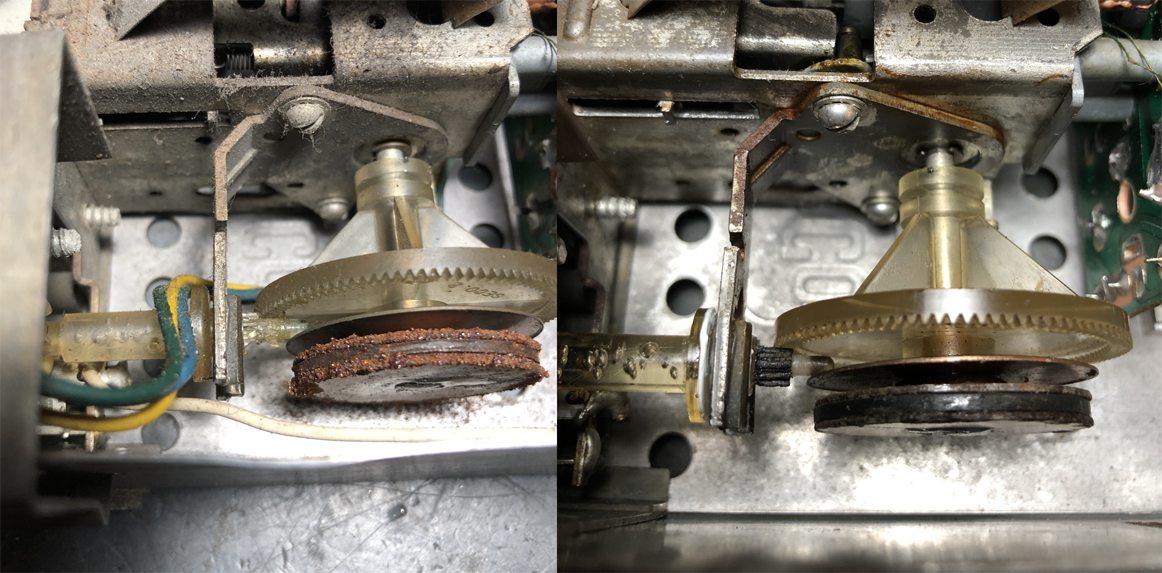
I have a 60s Ford or Mercury radio (Mustang or most Full Size) and the tuning knob doesn’t move/barely moves the dial or seems notchy.
It’s very common for some of these radios to have a stripped out drive gear. Some of these radios were originally built using an inferior plastic that has gotten overly brittle with time.
Replacement parts, both new and used, have dried up over time but we are able to rebuild the plastic components in house when the tuner and clutch are serviced. If your radio has stripped teeth, this will add $100 to the cost of conversion.
I have a 20s/30s era firewall mount radio with remote tuning head on flexible shafts, such as Motorola or Philco Transitone. Can you work with these?
These can be converted the same as most other radios, only considering speaker replacement cost and whether keeping it 6 volts.
Depending on the model, we can also replace the fairly large firewall unit with a smaller control box while keeping the original control head and eliminating the flexible shafts. Pricing depends on features desired and any special or other installation requirements.
Installation
How do I wire my Aurora converted radio?
Most converted radios eliminate the radio’s factory connectors and provide a more up to date molex style plug with detachable harness to wire in on the vehicle side.
On some radios, including those going into Concours or other show vehicles where an original appearance under the dash or use of the factory harness is desired, the factory connectors can sometimes be reused. This does usually limit the radios to a strictly stock speaker and accessory configuration.
The standard harness that comes with your Aurora conversion is the same as most modern aftermarket car stereos and is wired the same way. The FMR user’s manual included with your radio details wiring and various speaker arrangements in more detail.
Do I need new speakers?
Short answer: yes, if you don’t already have them. Reusing your factory speakers is not advised, even if they are in excellent original condition for a couple of reasons. First, these speakers were not designed to handle the total power output of the Aurora.
Secondly, many vehicles grounded one side of the speaker directly to the car’s body and ran only one wire back to the radio. While the Aurora can be adapted externally to drive speakers wired in this fashion, it will be at significantly reduced power. It’s advised that you replace the speakers and run an additional wire to the speaker location if at all possible.
What type of speakers do I need?
This one gets asked a lot. The quick answer is any quality car stereo speaker available on the market with at least a 4 ohm impedance and rated at least 45w peak power. In other words, pretty much anything that physically fits the location without interference. The Aurora can drive 2 ohm speakers, but use of more than one on any channel is not advised since it will reduce the Aurora amplifier’s power output capacity.
My car has a single speaker in the dash and/or I want to add speakers to the rear/package shelf, or has some arrangement other than four speakers.
This most commonly qualifies as a three speaker arrangement where the single dash speaker location is used and two are added to the rear. Those familiar with installation of modern aftermarket stereos and amplifiers are probably familiar with amplifier “bridging” to drive two separate channels into one speaker. Many installations sometimes require the use of either an external crossover network, a non-inductive resistor in series with the bridged speaker, a “dual voice coil” speaker, or other solutions.
None of these are required with the Aurora. In a three speaker installation, your rear channels are wired to the radio normally. The single front speaker is attached to the negative of one front channel and the positive of the other. While a “dual voice coil” style speaker can also be used in this instance, it is totally unnecessary. These were originally as a stop gap measure for use with early FM conversion systems and aftermarket stereos.
For best performance, keep something in mind. When your Aurora amplifier is bridged to mono in this way, it will see whatever speaker you have attached to it as half it’s rated impedance. This means a 4 ohm speaker will appear as a 2 ohm load, and as mentioned earlier in this FAQ, while the Aurora is capable of driving a single 2 ohm load, it will do so at slightly reduced power. It is highly advised that a speaker with an 8 ohm or higher voice coil is used which are generally available on the home audio aftermarket and elsewhere. Avoiding a 2 ohm load whenever possible is especially important in a tight dashboard installation where there may not be much airflow around the radio itself and cause overheating. If this does occur, the Aurora will sense this and throttle power back automatically.
What if my car has a single front and rear speaker, or just a single dash speaker?
Single speaker installations are simple. Attach the speaker to any of the up to four speaker wire pairs from the radio (preferably one of the front pairs.) That’s it. When the Aurora senses only one speaker attached at power on, it will default to mono mode without any reduction in power output. No external crossovers, bridging, or special dual voice coil speakers are necessary as with most aftermarket stereos.
In cars with a rear seat speaker option, wire the rear speaker to the total opposite “corner” speaker output. For example, if your dash speaker is attached to right front, wire the rear speaker to left rear. If your radio has a fader control option, wiring the speakers this way assures the fader will work as originally intended. Otherwise, the balance control accessible through the virtual EQ menu will adjust front/rear fade.
Does Sierra sell speakers for my car?
No, but there are many other reputable retailers to choose from.
My Chevy/Impala/Corvette or other GM vehicle uses an thin or unusual sized speaker and/or one with a nonstandard mounting arrangement.
Yes, GM commonly did this in the 1960s. More common are the 4″x10″ shallow form factor speakers. To complicate matters, some of these mounted to the dashboard using a proprietary metal strap designed to accommodate their speakers unique magnet shape.
In these vehicles there’s often not enough available depth to mount a more modern 4″x10″ aftermarket speaker due to their larger magnet size, and in these cars options are definitely limited without major structural modification.
Fortunately, there are specialty retailers such as Retro Manufacturing making modern production style speakers with appreciable added power handling capacity and OEM fit for these vehicles.
Using Your Converted Radio
How do I know what FM station I’m listening to on my converted factory AM only radio?
Since we don’t modify the original dial glass for several reasons, the best way to identify the current FM (or even AM) station is by summoning the Aurora Voice Assist (available on all conversion tiers, including basic) by turning the volume knob up and down three times. That’s clockwise-counterclockwise three times. The voice assist will announce the currently tuned station.
On some radios with Bluetooth and all radios with a Bluetooth Premium conversion, an optional pushbutton, available at additional cost, can be used to summon the voice assist. It can also be used to enable Bluetooth pairing modes and even answer/hang up incoming calls, all in lieu of various volume/tone knob rotation methods.
How do I switch over to the AUX input?
Most radios come programmed in what’s called VOX mode, which is automatic signal sensing. This means that a cord can be left attached to the jack on the rear of the radio for simplicity, and will automatically switch over from the tuner as soon as audio playback from your external device is sensed.
Keep in mind that Bluetooth audio playback is also automatic and supersedes the AUX input jack. If your Bluetooth enabled radio has a device actively paired to it, it may be necessary to unpair the device for the AUX input to function.
Some customers opt to have their radio programmed so that the AUX input is enabled manually only when the radio is tuned to one extreme end of the dial, but this is only done on request. Your radio’s user manual will indicate how your radio is configured. If not requested, it will come programmed in VOX (automatic) mode.
How do I listen to a cassette or 8-track cartridge?
Tape playback on radios with a converted/restored built-in or external tape option is handled automatically in most cases. The radio will switch over from tuner automatically as soon as a tape is inserted and audio is sensed. Once the tape is ejected and/or playback is halted, the radio will return to tuner automatically after several seconds.
Since every radio is different and every conversion complex, not all tape deck integrations are handled the same. If your radio also has Bluetooth, then in most cases Bluetooth pairing/playback will override tape playback, though this is not always the case. Your mobile device might need to be unpaired in order to hear tape playback. These details will be notated on the back of your User’s manual.
How do I adjust fader, balance, loudness, and other controls?
Most older radios did not come with any sort of provisions for speaker fade or balance. Only in the 1950s did the industry start seeing optional speaker fade controls with the introduction of rear seat speaker options. Your radio will have been adapted to use these controls if present or provided with the radio when sent in for conversion.
For radios without, all of these modern adjustments can be accessed through the Aurora Virtual EQ menu which is accessed with a distinct pattern of turns of the tone knob. Bluetooth enabled radios also accept/reject incoming calls, summon Siri, Cortana, or other AI assistant, or enable Bluetooth pairing mode by swiveling the volume control. See the user’s manual or quick reference card available on the Downloads page for more info on accessing these menu functions.
Other
Are there any other things to consider about the radio conversion process?
The main page and FAQs pretty much cover everything.
Be aware that any customer equipment left for over 90 days either without a deposit, followup payment installments, or final payment will be considered abandoned. If you are not able to make of follow up on payments during or after your radio has been completed then Sierra Classic Car Audio assumes no responsibility on your behalf and will not be responsible for any equipment left after 90 days of initial receipt, regardless of status or condition. These terms are non-negotiable.
 Sierra Classic Car Audio